
Van den Herik dredges emission-free with hydrogen vessel Prins 6
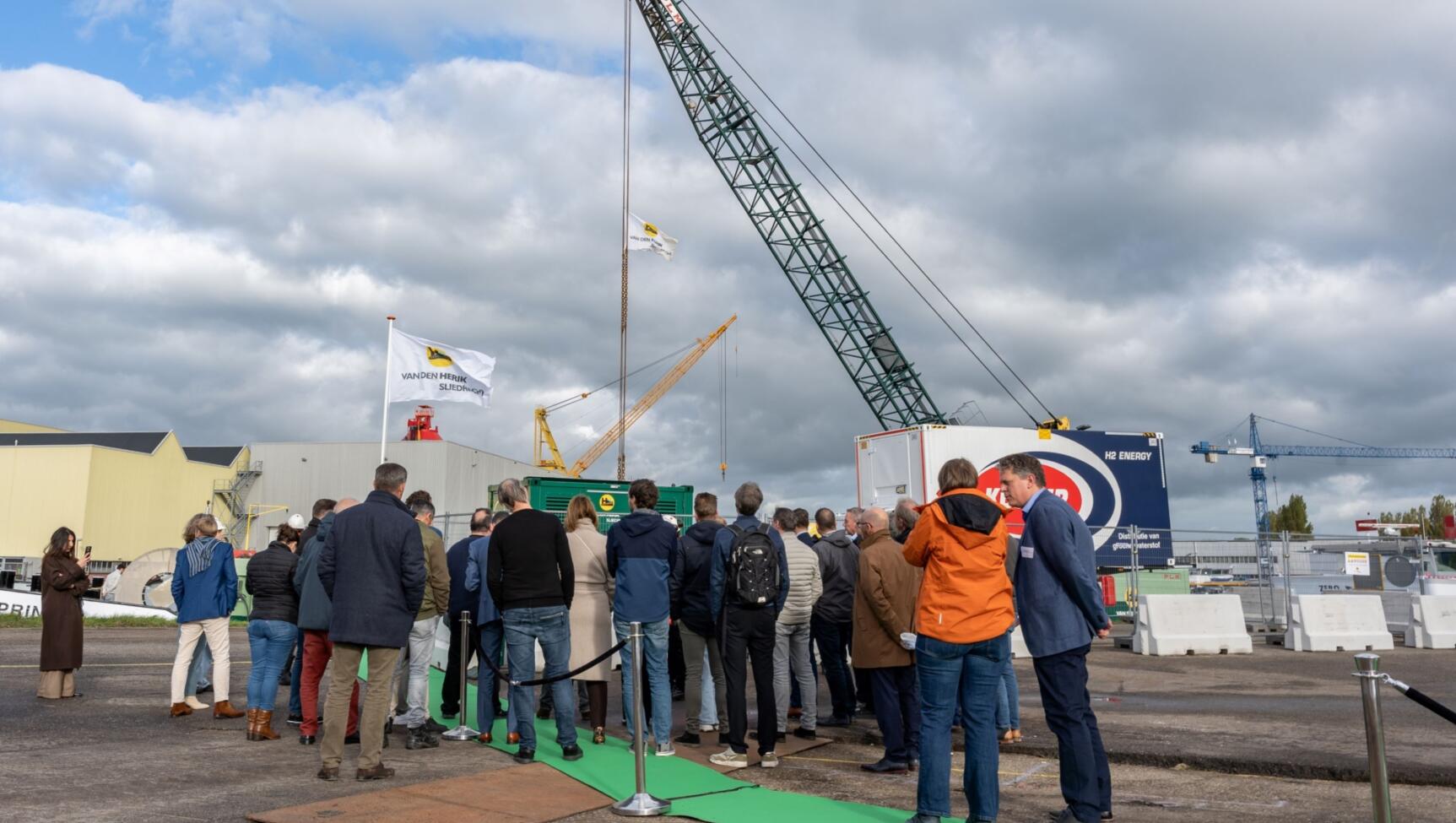
Dredging company Van den Herik has converted its 65-meter work vessel Prins 6 into a zero-emission version, officially presented on Thursday, 30 October, as the Prins ZEs. In the ship’s side pontoons, batteries with a total capacity of about 2 MWh have been installed, allowing dredging operations on the Gelderse IJssel to take place entirely without emissions.
Because fuel cells are not yet legally permitted on board, the company developed a mobile hydrogen fuel cell system onshore in Sliedrecht. This unit supplies electricity via a trailer with high-pressure hydrogen (up to 381 bar, supplied by Kuster H2 Energy) to recharge the onboard batteries in roughly 12 hours.
The mobile unit is compact (about 2 x 3 meters) but can produce 3,600 kWh per day — enough to power around 400 households and to fully recharge the Prins 6 approximately five times. The batteries provide direct current, which is converted onboard into alternating current to power the electric rudder propeller, bow thruster, and crane. Two diesel generators have been retained as backup. The installation was carried out by Verhoef Elektrotechniek and Kooiman Marine Group; recharging must take place within an ATEX safety zone established along the dredging route.
Rijkswaterstaat (RWS) acted as a driving force behind the project: the government agency aims for fully emission-free operations by 2030 and contributes to additional costs in tenders, while market parties make the investments. The transformation cost Van den Herik around €3.5 million. Managing director Isolde Struijk emphasized that the family-owned company invests with a long-term vision and is also preparing other sustainable projects, such as an energy hub on the quay and a trailing suction hopper dredger running on methanol.
Member of the European Parliament Jannette Baljeu and regional stakeholders confirmed that both hydrogen legislation and the availability of green hydrogen — including through a planned 10 MW H2 Hub near Sliedrecht — are crucial to making such innovations scalable.