

Hydrogen Milestone for Groningen
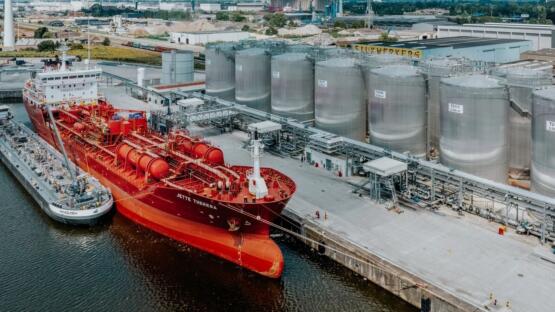
With the arrival of the BaseLoad Power Hub in the Eemshaven, a new milestone has been reached for the Dutch energy transition and for the development of the Groningen Hydrogen Valley. The innovative installation is the first platform for hydrogen production and storage designed and built for offshore conditions. On October 3, Crosswind, a joint venture of Shell and Eneco, handed over the platform to its new owner, DOT, for further knowledge development in hydrogen production.
The BaseLoad Power Hub arrived in the Eemshaven on September 27 at 5 p.m., after a sea voyage from Italy, where the compact hydrogen production and storage platform had been built over two years. The platform measures 23 by 46 meters, weighs 1,800 tons, and combines a 2.5 MW electrolyzer, 1,200 kilos of hydrogen storage, and a conversion module with a 1 MW electric battery and 5 MWh storage capacity.
In Groningen’s Eemshaven, a new destination has been found for the hydrogen platform. The new owner, DOT (Delft Offshore Turbine), will use the BaseLoad Power Hub—renamed Phynix—for further research to gain more insights into green hydrogen production and storage. DOT is seeking collaboration with universities and industry partners, while a team from Shell Technology will remain involved with the platform.
Investing in Northern Netherlands
“We are proud of our contribution to this green hydrogen platform,” said Frans Everts, CEO of Shell Netherlands. “By handing it over to DOT, we promote further knowledge and innovation in the energy transition. It is excellent that this project is taking place in the north of the Netherlands and contributes to the hydrogen economy in Groningen.”
“The demand for green hydrogen as a carrier of sustainable energy is still small, but as soon as demand grows, the sector must be ready to scale up quickly and efficiently,” added Karen de Lathouder, Chief Operating Officer Assets at Eneco. “That’s why research into hydrogen production and storage is so important. This will enable us to use hydrogen as a flexible energy source in the future, helping to reduce grid congestion.”
Future Applications of Green Hydrogen
As the new owner, DOT, founded in 2014, aims to contribute to the development of Groningen’s and the Netherlands’ hydrogen technology. DOT sees Phynix as the ideal place where education, industry, government, and knowledge institutions can work closely together to rapidly translate innovation into skills and real-world applications.
“Phynix demonstrates how learning, scaling, and training can go hand in hand,” said Jan van der Tempel, director of DOT. “We are starting on land to build capacity while developing and sharing knowledge. The ultimate goal is the North Sea, where the installation can contribute to the hydrogen supply of tomorrow.”
Dutch Hydrogen Economy
The new future of the hydrogen platform is supported by stakeholders including the Groningen Seaports authority and MissieH2, the industry association for Dutch hydrogen companies.
“Through the Eemshaven, Groningen Seaports is an international leader in offshore energy development,” said Bart-Jan Hoevers, CEO of Groningen Seaports. “With the arrival of the BaseLoad Power Hub, we strengthen our position as a testbed for innovative hydrogen technology. This project shows how, as an energy port, we can provide the right environment in collaboration with regional companies and knowledge partners, directly contributing to the strengthening of the Hydrogen Valley.”